Multi BA potentiostat
For measurements with multiple working electrodes in the same cell
What is Multi BA?
The Multi BA system is a specially modified PGSTAT302N instrument designed for parallel electrochemical measurements on six working electrodes simultaneously.
It allows the addition of up to five MBA modules to the main PGSTAT302N potentiostat. The PGSTAT302N itself serves as the first working electrode, while each MBA module adds one additional working electrode, resulting in a total of up to six working electrodes (1× PGSTAT302N + 5× MBA, which is user configurable).
All six working electrodes operate simultaneously within the same electrochemical cell, sharing a single reference electrode and a single counter electrode. This configuration enables synchronized measurements under identical environmental conditions, making Multi BA ideal for comparative studies and high-throughput screening for sensor research.
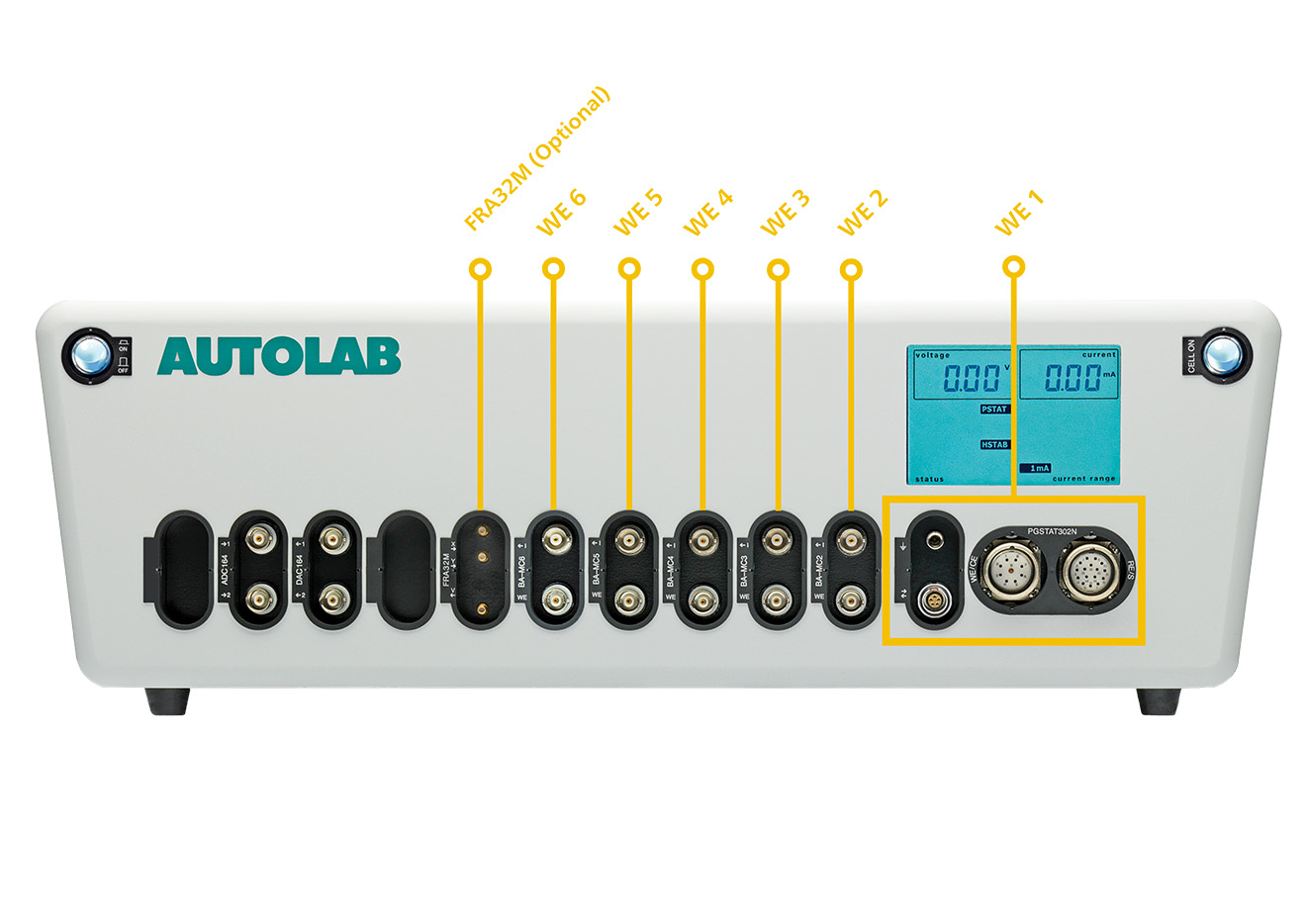
PGSTAT302N Multi BA system
What are the differences between Multi BA, Multichannel and Multiplexer
Multi BA vs Multichannel potentiostat
The main difference between Multi BA and MultiChannel potentiostat lies in the electrode configuration. Multi BA can perform measurement on up to six working electrodes within a single electrochemical cell, all sharing one counter electrode and one reference electrode. This setup allows simultaneous measurements under identical environmental conditions, but all reactions occur within the same shared cell.
Multichannel potentiostats, on the other hand, consist of multiple fully independent potentiostats. Each channel includes its own working electrode, sense electrode, counter electrode, and reference electrode, forming a complete electrochemical cell. This allows for simultaneous measurements on up to 12 separate cells within one MAC204 or MAC101 cabinet —such as individual batteries—each operating independently but under the same environmental conditions.
Multi BA potentiostat vs Multiplexer
The key difference between Multi BA and the Multiplexer (MUX-SCNR16) lies in the timing of the measurements. Multi BA system enables true parallel measurements by allowing all electrochemical reactions to occur simultaneously on up to six working electrodes. These electrodes share one single reference and one single counter electrode within one electrochemical cell, ensuring that all reactions take place under identical environmental conditions.
In contrast, the multiplexer module performs sequential measurements. Each working electrode is measured one after the other. Once an experiment finishes on one electrode, the NOVA software automatically switches to the next, again using the same reference and counter electrodes.
The main advantage of the MUX-SCNR16 is scalability: it supports up to 128 working electrodes in a single electrochemical cell, making it suitable for applications requiring a large number of working electrode measurements, but not simultaneously.
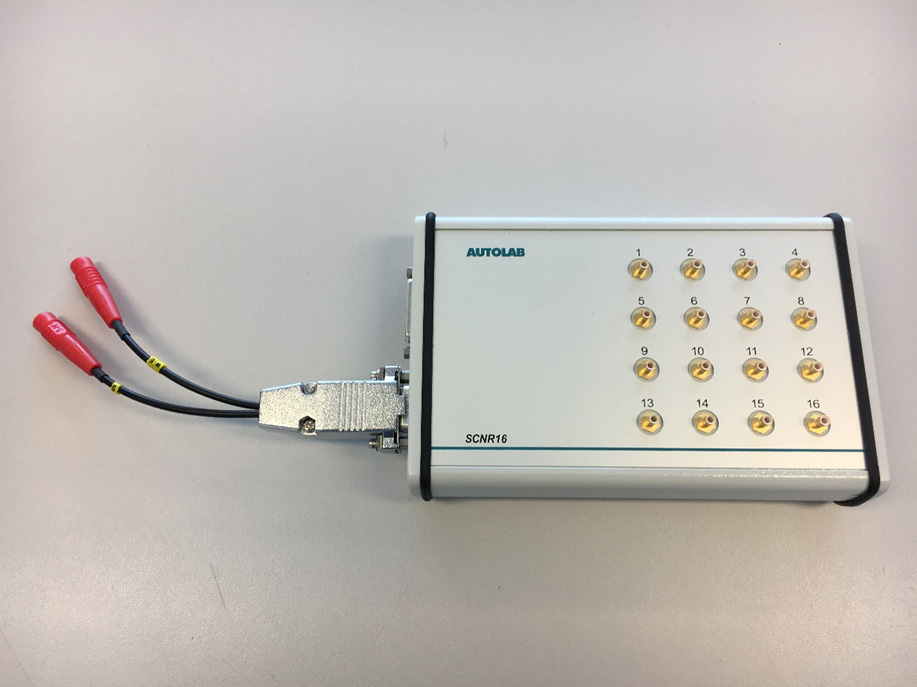
Metrohm Autolab Multiplexer (MUX-SCNR16)
When do you need a potentiostat with Multi BA feature?
The Multi BA system is essential for multi-electrode measurements, where the experimental setup has multiple working electrodes (WE) in the same electrochemical cell, sharing a common counter electrode (CE) and a common reference electrode. This configuration is particularly valuable when simultaneous electrochemical measurements across an array of electrodes are needed.
Typical use cases include sensor development and corrosion testing. It makes it possible to screen several samples simultaneously, saving time while ensuring consistent conditions (same temperature, solution, and measurement environment, without variability).
For example, when working with screen-printed electrodes in a single cell, a MultiBA system enables parallel measurements on up to six working electrodes. This makes it ideal for researchers using an array of biosensors to detect different biomarkers in a blood sample simultaneously. It's also perfect for the rapid screening of materials, where researchers can place different catalysts on different working electrodes on a single plate. By connecting them all to the same common counter and reference electrode, you can run an identical electrochemical experiment (like cyclic voltammetry or chronoamperometry) on all materials at once.
This setup allows for the simultaneous detection of up to six active surfaces, enabling the differential analysis of six analytes in a single solution. As a result, the MultiBA provides a versatile electrochemical platform suitable for advancing (bio)sensing technologies across various sectors and research fields, including healthcare, environmental monitoring, and food safety.
Why should you choose PGSTAT302N MultiBA?
The MultiBA system offers a unique combination of capabilities by integrating the powerful PGSTAT302N potentiostat with up to six working electrodes —optionally equipped with FRA32M for impedance measurements on the first working electrode.
With the ability to perform simultaneous measurements on multiple electrodes within a single cell, researchers gain maximum versatility and efficiency, making MultiBA one of the most adaptable platforms available in the field of sensor development and material screening.
Hardware specification PGSTAT302N MultiBA
| Hardware Specifications | Working Electrode 1 | Working Electrode 2-6 |
|---|---|---|
| Potential range | +/- 10 V | +/- 10 V |
| Compliance voltage | +/- 30 V | - |
| Maximum current | +/- 2 A | +/- 50 mA |
| Current ranges | 1 A to 10 nA , in 9 decades | 10 mA to 10 nA , in 7 decades |
| Potential accuracy | +/- 0.2% | +/- 0.2% |
| Potential resolution | 0.3 µV | 0.3 µV |
| Current accuracy | +/- 0.2% | +/- 0.2% |
| Current resolution | +/- 0.0003% (of current range) | +/- 0.0003% (of current range) |
| Input impedance | > 1 TOhm | - |
| Potentiostat bandwidth | 1 MHz | 1 MHz |
| Control software | NOVA | NOVA |
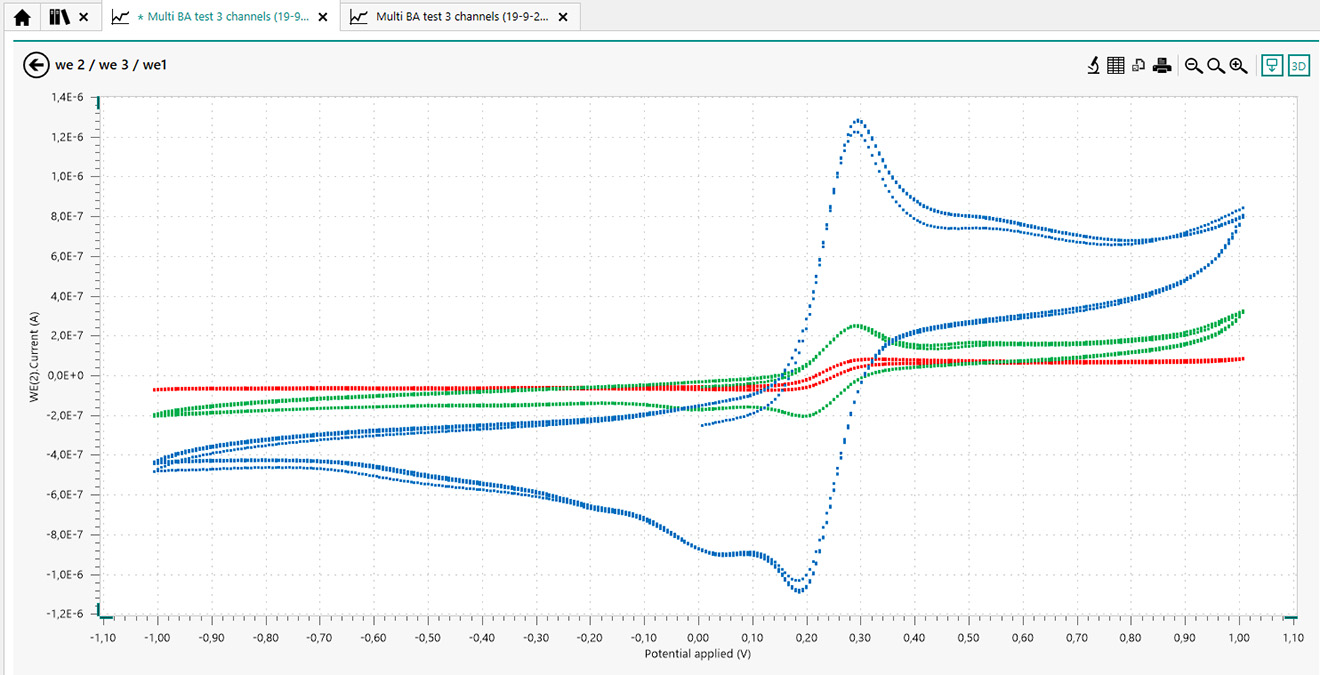
The plot above shows a cyclic voltammetry measurement, with all the data from each WE displayed simultaneously in the NOVA software..
Compatible accessories
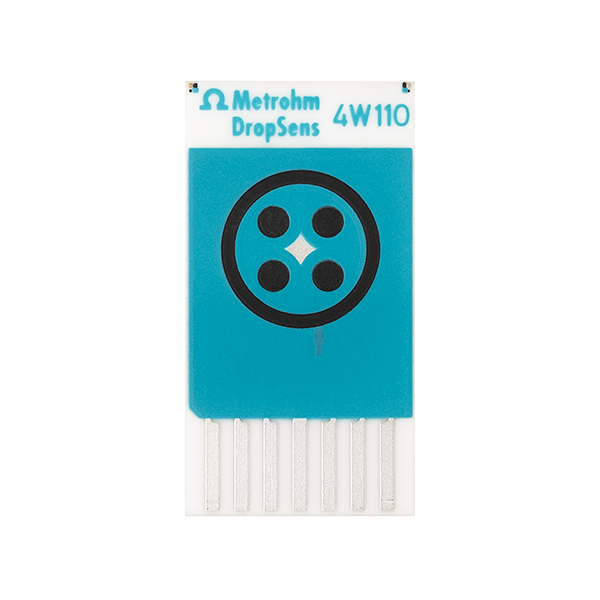
Screen-printed electrode
DRP-4W1110-U20
- Number of WEs: 4 WE
- Working electrode material: Carbon
- Working electrode diameter: 0.29 cm
- Working electrode position: 4 working electrodes sharing auxiliary and reference electrode in the middle of the strip.
- Auxiliary electrode material: Carbon
- Reference electrode material: Silver
Contact our local experts for tailored recommendations based on your research
FAQ - Multi-bipotentiostat (Multi BA), Bipotentiostat (BA)
The Bipotentiostat (BA module) is particularly useful in specific applications—such as when working with a Rotating Ring-Disk Electrode (RRDE) or a single screen-printed electrode that includes two working electrodes, such as DRP-X1110-U75.
In Metrohm Autolab, we have multiple products with BA functionality, i.e. AUT302N, PGSTAT204. M204, M101.
However, when more than two working electrodes are required within the same electrochemical cell, other solutions are recommended:
- MultiBA: for simultaneous measurements on up to six working electrodes
- Multiplexer Module (MUX-SCNR16): for sequential measurements on up to 128 working electrodes
These systems offer greater flexibility and scalability for complex sensor development and multi-analyte detection.
We’re here to help
Our colleagues are happy to assist you, providing local support in over 120 countries worldwide.

